

Recover unclaimed neighbouring rights royalties at scale.
FiinD is a boutique agency focused on maximising Neighbouring Rights royalties for the top tier of global performers and producers, combining specialist royalty administration with proprietary auditing software.
The Challenge
Royalties are being generated at global scale, but too much of it never reaches the right people.
The money exists. The usage exists. The problem is identity, attribution, and fragmentation across territories, platforms, and rights types. When metadata breaks, revenue doesn’t stop. It just gets delayed, misdirected, or parked.

1) The industry runs on mismatched identifiers
Tracks, recordings, contributors, and ownership splits are represented differently depending on the platform, the territory, and the collection route. A single recording can accumulate multiple IDs, inconsistent naming, partial credits, and outdated splits. The result: millions of legitimate usages that cannot be confidently matched to the right rightsholders.

-
Multiple “sources of truth” — no single, trusted view of the recording, contributors, and splits.
-
Territory-by-territory fragmentation — different rules, societies, formats, and evidence requirements.
-
Manual remediation — spreadsheets, emails, PDFs, and slow back-and-forth to prove ownership.

2) When matching fails, money accumulates at an industrial scale
A clear signal of the problem is the sheer volume of unmatched royalties that build up when usage cannot be properly attributed. In the US alone, The Mechanical Licensing Collective reported $424,384,787 in historical unmatched royalties accrued, alongside a dataset measured in billions of lines.
Leakage at scale
When metadata doesn’t align, royalties don’t land where they should.
-
$424.4m
Historical unmatched royalties accrued by The MLC (US mechanicals), where usage exists but attribution does not.
-
9bn+
Lines of sound recording & ownership data in scope, illustrating the scale of matching complexity.
-
1.3TB
Approximate size of the dataset referenced in The MLC’s matching and claims process.
3) The market is growing which increases both the opportunity and the leakage
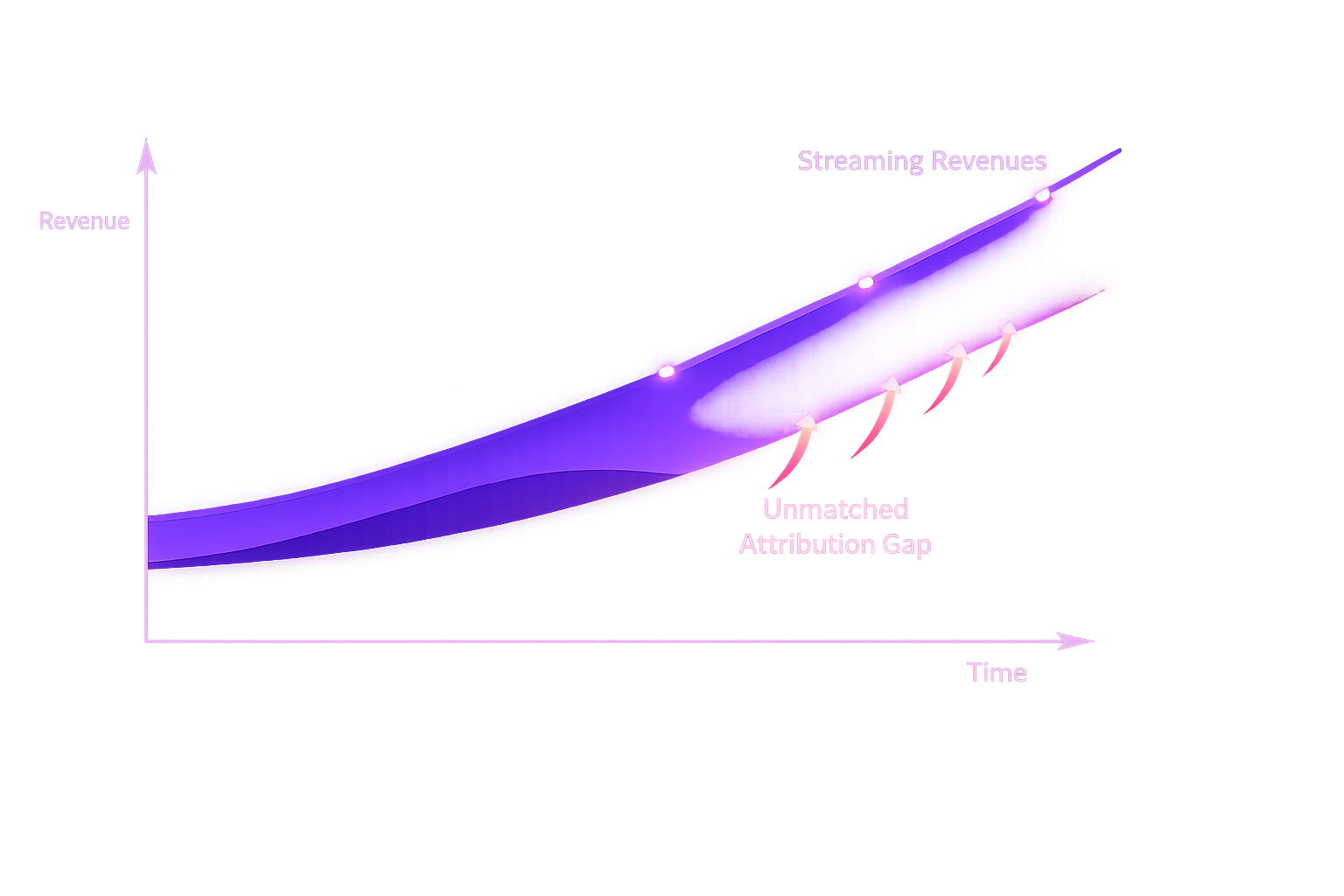
Global recorded music revenues continue to rise, driven by streaming subscriptions and performance rights. That growth is positive but it also amplifies the cost of inaccurate identity, attribution, and claims processes. The bigger the pool, the bigger the “lost and delayed” slice.
-
$28.6bn
Global recorded music revenues (2023), reflecting the scale of rights flows moving through the ecosystem.
-
$29.6bn
Global recorded music revenues (2024), marking continued market growth and compounding matching pressure.
-
$2.9bn
Performance rights revenues (2024), a large and growing pool where accurate attribution is critical.
What this means in practice
-
Creators wait — delayed payouts while evidence is gathered and matches are resolved.
-
Rightsholders lose confidence — opaque statements and inconsistent claim outcomes.
-
Platforms and administrators carry cost — support overhead, disputes, and manual operations.
Fiind is being built to attack this root problem: identity, evidence, and attribution so that legitimate royalties can be claimed faster, at higher confidence, and with far less manual effort.
The Platform
A proprietary auditing and claims engine built to find, prove, and collect neighbouring rights.
FiinD’s platform applies advanced algorithms to uncover missed revenue opportunities, recover retroactive royalties, and support comprehensive claims, including detecting samples used in recordings so royalties can be asserted with confidence.
It is designed for the real-world messiness of rights data: inconsistent identifiers, fragmented sources, and disputes that demand evidence. The goal is simple: turn “possible royalties” into “provable claims”.
Core capabilities
-
User Profiles — register and maintain repertoire data in a consistent structure.
-
Multi-Database Search — identify unlinked or unregistered works across sources.
-
Dashboard — track collected vs. uncollected royalties at a glance.
-
Automated Audit Trails — compile claim-ready evidence and an audit history.
-
API Integration — connect to collection societies and DSPs for data flow and validation.
-
AI Integration — NLP matching, duplicate detection, metadata normalisation, and audio fingerprinting.
-
Advanced Search Algorithms — scrape and match sound recordings to uncover omissions.
Built for scale, built for proof
The platform exists to compress time-to-insight, improve match confidence, and make disputes winnable with evidence.
-
Hours, not weeks
Rapid analysis accelerates onboarding and surfaces gaps quickly. The platform is designed to do in hours what manual work takes weeks.
-
Evidence-first claims
Automated audit trails and dispute tracking are geared towards producing claim-ready evidence, not just “flags”.
-
Connected ecosystem
API integration and global registration workflows align data with societies and DSPs so corrections and claims can be executed cleanly.
How it works end-to-end
The operating model is deliberately linear: onboard fast, audit deeply, correct registrations, recover retroactive value, and manage claims with evidence.
-
Quick onboarding
Rapidly analyse data and surface gaps early.
-
Comprehensive audits
Examine each royalty statement to ensure all tracks are accounted for.
-
Royalty administration
Correct registrations globally and integrate with societies for accurate data.
-
Retroactive collection
Secure eligible retroactive royalties to unlock additional income.
-
Claims management
Track disputes and provide evidence to secure rightful royalties.
What this unlocks
-
More recoveries — identify unregistered works and missed revenue opportunities faster.
-
Less friction — reduce manual back-and-forth by producing structured evidence and audit trails.
-
Higher confidence — matching plus fingerprinting reduces duplicates and improves attribution accuracy.
Market
A large, growing royalty segment — with significant inefficiency and recoverable value.
Neighbouring Rights is a meaningful revenue stream for performers and producers, but the market remains operationally complex: fragmented identifiers, incomplete registrations, and “black box” royalties create persistent under-collection.
FiinD’s wedge is straightforward: focus on the high-value end of the market (where revenue concentrates), then use software-led auditing to surface omissions quickly and convert them into evidence-backed corrections and claims.
-
Global recorded music
0
-
Neighbouring Rights
0
-
Unclaimed “black box”
0
-
Revenue concentration
0
Why this market is attractive
- Rapid growth in Neighbouring Rights increases the recovery pool over time.
- Concentrated revenue enables an efficient, high-ROI client acquisition strategy.
- “Black box” royalties represent material, recoverable upside.
- Proven exit precedent exists in the sector for scaled NR platforms.
FiinD’s wedge
- Target the top end of the market where the value concentrates.
- Software-led auditing reduces manual load and compresses time-to-insight.
- Evidence-first outputs reduce disputes and improve claim success rates.
- Repeatable process: onboard → audit → correct → recover → manage claims.